
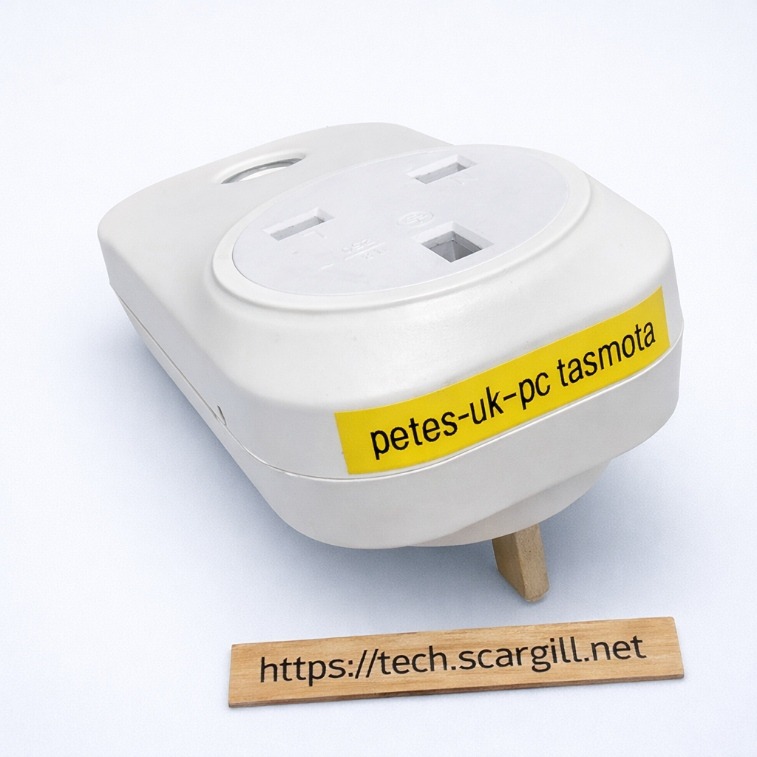
With humble apologies to those of you who use TASMOTA all the time…. TASMOTA is a piece of firmware for IoT devices running on ESP8266 and ESP32 that has been around for a long, long time. It runs entirely locally on your network, there are no adverts, there is no gimmickry, it is a great example of open-source freeware. Many people have contributed to this software, which is one reason why it has lasted so long and worked so well.
The image you see is my smartplug to which I inserted Tasmota. It was originally a Sonoff S20 Smartplug and is able to switch 10A max and it’s standby current is < 0.3w. Tasmota is even today regularly updated – this afternoon I upgraded the switch to version 15.2 just because I could – a simple OTA operation that takes a minute and involves no effort, just the ability to follow a simple instruction.
I have several smart switches which use TASMOTA. I have them in my home in England and in my home in Spain. The two are connected by TailScale, so I can access both routers from my phone without any signals going off to China or anywhere else. Smart switches are just one of the uses for TASMOTA, and the one I’ll cover here. Something that is sadly missing on the vast majority of smart switches is the facility to store a secondary access point.
So for example, my smart switch here, referred to as petes-uk-pc, can, unlike many other smart plugs, seamlessly be physically transferred from one Wi-Fi installation in one building to another Wi-Fi installation in another building simply because the first SSID I have entered into the device is the SSID of my Wi-Fi access point in the house here in the UK. The second SSID is the SSID of my Wi-Fi access point in the outbuilding here in the UK.
Just now I realised that I’d left the smart plug in the outbuilding, despite bringing the PC into the house, and noticed that it was still working fine though obviously not connected to anything. I simply brought the unit into the house, plugged it in to a wall socket, and a minute or two later, it was working. Why? Because it could access the outside SSID? No! Because it had automatically switched over to the secondary SSID.
In each case, the plug connects to the same MQTT broker no change required there. I know, this sounds trivial but it is incredibly handy.
esphome supports that, too:
https://esphome.io/components/wifi/#connecting-to-multiple-networks
That’s handy. I didn’t know that. Good – now I do..
wifi:
networks:
– ssid: FirstNetworkToConnectTo
password: VerySafePassword
– ssid: SecondNetworkToConnectTo
password: VerySafePassword
# Other options
# …
as specified in that page, better using secrets than explicit info in yaml… this way, if you change them, you need to just recompile without touching each yaml again…
Absolutely.
Indeed – take a look at the new ESPHome Release notes – they specifically mention automatically picking up the best of multiple access points… the 2026 release notes make for very interesting reading – for that reason and for their decision to stop minimising the usefulness of the ESP8266, rather, to embrace the fact that millions of ESP8266’s are and will remain in use for years to come. https://esphome.io/changelog/2026.1.0/
I have a LOT of ESP8266 devices running Tasmota as in the past, ESPHome use on these DIRT CHEAP devices seemed to be discouraged – not any more.